Commercial cleaning is more than removing visible dirt. For office managers, property owners and facility teams, a dependable cleaning program supports building presentation, surface maintenance, workplace hygiene and consistent operations. Yet comparing janitorial proposals can be difficult when contractors describe their work differently.
This research-informed guide combines published U.S. government statistics with a practical, original Commercial Cleaning Performance Scorecard that buyers can use to evaluate contractors. The scorecard is an editorial decision tool, not a government certification or a validated research instrument.
1. Commercial cleaning industry statistics: what the data reveals
According to the U.S. Bureau of Labor Statistics (BLS), janitors and building cleaners held approximately 2,432,600 jobs in 2025. The BLS reported a May 2025 median hourly wage of $17.71 and a median annual wage of $36,840. Employment is projected to grow 2% from 2025 to 2035, with approximately 321,800 job openings annually, on average, primarily reflecting replacement needs.
| U.S. labor-market measure | Published figure |
|---|---|
| Jobs in 2025 | 2,432,600 |
| Median hourly pay, May 2025 | $17.71 |
| Median annual pay, May 2025 | $36,840 |
| Projected job growth, 2025–2035 | 2% |
| Average annual openings, 2025–2035 | 321,800 |
Source: BLS Occupational Outlook Handbook. National workforce data do not describe Crest Cleaning’s employees, prices or performance.
For building managers, these figures underscore the importance of contractor staffing and continuity. A written cleaning plan is useful only when a provider can reliably assign workers, train replacements and supervise the work. Ask how absences, turnover and quality complaints are handled before choosing a vendor.
2. Cleaning, sanitizing and disinfecting are different activities
The Centers for Disease Control and Prevention (CDC) distinguishes routine cleaning from sanitizing and disinfecting. Cleaning removes dirt and many germs; sanitizing reduces germs to specified safe levels; disinfecting uses products intended to kill remaining germs on surfaces.
Routine cleaning is often sufficient in ordinary settings. Additional disinfection may be appropriate when specific illness-related or facility risks justify it. A credible contractor should describe the products, target surfaces and conditions for each procedure rather than promise blanket disinfection everywhere.
Frequently touched areas—such as door handles, elevator controls, reception counters and restroom fixtures—deserve particular attention. For facilities with regulated activities, applicable sector-specific requirements take precedence over general office guidance.
3. Worker safety is part of cleaning quality
Cleaning teams work with chemicals, equipment and sometimes wet or slippery surfaces. The Occupational Safety and Health Administration (OSHA) advises employers to train workers in cleaning-chemical hazards, maintain labeling and safety information, provide appropriate protective equipment and avoid unsafe chemical combinations. Additional background is available from CDC/NIOSH’s custodial worker safety resources.
Before signing a contract, ask how cleaners access Safety Data Sheets, how products are stored and diluted, and how incidents are reported. Safety procedures should be part of routine operations—not an afterthought during procurement.
4. Compare commercial cleaning service models before comparing prices
| Service model | Typical use | Key question |
|---|---|---|
| Recurring office cleaning | Offices and administrative spaces | Which tasks are included at each visit? |
| Full-service janitorial | Mixed-use or larger buildings | How is supervision handled? |
| Day porter | Busy, occupied buildings | What response times are expected? |
| Periodic deep cleaning | Restorative and detail work | What is the exact project scope? |
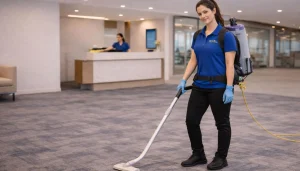
| Commercial carpet cleaning | Carpeted workspaces | How are drying and disruption managed? |
A small building with heavy visitor traffic can need more frequent restroom and entry cleaning than a larger low-occupancy office. Compare proposals against the same scope, service frequency and inspection criteria. Crest Cleaning describes its commercial cleaning services and office and janitorial cleaning options for businesses evaluating a service plan.
5. Original tool: Commercial Cleaning Performance Scorecard
The following weighted scorecard helps property managers compare proposals on more than price. Give each category a score from 0 (no supporting evidence) to 5 (strong documented evidence). Multiply each score divided by five by its category weight, then add the results.
| Evaluation category | Weight |
|---|---|
| Cleaning scope and task clarity | 25% |
| Staffing and supervision | 20% |
| Safety and chemical procedures | 20% |
| Quality assurance and issue resolution | 20% |
| Scheduling and flexibility | 15% |
Formula: Total score out of 100 = Σ[(category rating ÷ 5) × category weight].
Example comparison: two hypothetical cleaning proposals
| Criterion | Contractor A | Contractor B |
|---|---|---|
| Scope clarity | 5 | 3 |
| Staffing | 4 | 3 |
| Safety | 4 | 4 |
| Quality assurance | 5 | 2 |
| Flexibility | 3 | 5 |
| Weighted score | 86/100 | 66/100 |
Illustrative ratings only. No actual vendors or Crest Cleaning results were scored. This is a proposed procurement framework, not a scientific benchmark.
The framework makes trade-offs explicit. Contractor B may offer better scheduling flexibility, while Contractor A may provide stronger documented scope and quality processes. The right decision still depends on contract terms, references, insurance, applicable licensing and building-specific requirements.
6. How often should commercial facilities be cleaned?
No single cleaning frequency fits every property. Start with a room-by-room inventory and classify spaces by occupancy, visitor traffic, surface use and risk. Restrooms, entrances, breakrooms and shared touchpoints may need daily or more frequent attention; low-use spaces can follow a different schedule. Periodic projects may include detailed floor care, carpet extraction or restorative cleaning.
Frequency should be adjusted using observed conditions and documented complaints—not arbitrary promises. Ask vendors to specify what “daily,” “weekly” and “deep cleaning” mean in the written scope.
7. Commercial carpet cleaning deserves its own maintenance plan
Entryways, corridors and meeting rooms experience different levels of tracked-in soil. A carpet maintenance plan should consider carpet type, manufacturer instructions, soil load, spot treatment, cleaning chemistry and drying time. The CDC also discusses routine care for soft surfaces in its facility cleaning recommendations.
For local business properties, explore Crest Cleaning’s commercial carpet cleaning services and request a scope appropriate to the facility’s materials and schedule.
8. Illustrative office case: building a measurable cleaning plan
Consider a hypothetical 15,000-square-foot office with shared meeting rooms, carpeted work areas, two restrooms and a busy entrance. The facility manager could establish a baseline by photographing recurring issues, recording occupant complaints and listing tasks by area. Next, the manager could require a contractor to document completed work, inspect critical areas and respond to issues through an agreed escalation process.
After several weeks, the manager could review inspection records and revise service frequency where needed. This is a planning scenario, not a real Crest Cleaning customer case study; no cost savings or performance outcomes are claimed.
9. Questions to ask a commercial cleaning company in Auburn, WA
Businesses comparing providers in Auburn and surrounding areas such as Kent, Tukwila, Federal Way and Sumner should ask: What is included or excluded? Who supervises the work? How are staff absences covered? What chemical-safety training is provided? How are complaints tracked? Can the provider supply appropriate references and insurance documentation?
Location alone is not proof of service quality. Look for a written scope, transparent expectations and a workable process for resolving missed tasks. Crest Cleaning Services LLC offers information on its commercial cleaning and office janitorial cleaning services.
10. Conclusion: evaluate reliability, not only the monthly quote
Commercial cleaning decisions affect daily building operations. BLS labor statistics show the scale of the workforce, while CDC and OSHA guidance explain important cleaning and safety considerations. The original scorecard above gives buyers a transparent starting point for evaluating vendor proposals.
Ready to discuss your facility’s cleaning requirements? Request a commercial cleaning quote from Crest Cleaning Services LLC and outline your building type, priorities and preferred schedule.
Sources, methodology and further reading
- BLS: Janitors and Building Cleaners — national jobs, pay and projections.
- CDC: When and How to Clean and Disinfect a Facility — cleaning and disinfecting guidance.
- OSHA: Protecting Workers Who Use Cleaning Chemicals (PDF) — worker safety.
- CDC/NIOSH: Cleaning and Custodial Services — workplace risks.
- Wikipedia: Commercial Cleaning — general terminology only, not a statistical authority.
Editorial methodology: Government-source facts were checked against the linked references. The vendor scorecard and office scenario are original illustrations, not primary survey results, verified customer cases or a validated industry standard. Published statistics should be reviewed when sources update.