Infection control cleaning isn’t optional in medical offices and shared care spaces-it’s the foundation of patient safety. Pathogens spread through high-touch surfaces faster than most managers realize, and standard cleaning alone won’t stop them.
We at Crest Cleaning Services know that proper disinfection requires more than good intentions. You need the right products, correct contact times, trained staff, and documented proof that the work was done right.
Disinfectants That Actually Work
EPA-Registered Products Meet Standards, But Application Matters
EPA-registered disinfectants are non-negotiable in medical offices and care sites, but not all registered products perform equally. The EPA registration confirms that the product meets efficacy standards for killing specific pathogens, yet managers often overlook a critical detail: contact time. A disinfectant only achieves its rated pathogen elimination if it stays wet on the surface for the manufacturer’s specified duration, typically between 30 seconds and 10 minutes depending on the product and pathogen. Many cleaning staff apply disinfectant and wipe it dry in under a minute, rendering the product ineffective. The CDC emphasizes that cleaning surfaces first to remove visible soil is mandatory before disinfection, because dirt and organic material shield pathogens from chemical contact.
Match Disinfectants to Your Specific Pathogen Threats
Choose disinfectants based on the specific pathogens you face, not brand reputation. A product effective against norovirus may underperform against bacterial spores. Review the EPA label for the pathogens listed, and cross-reference against common infections in your region and patient population.
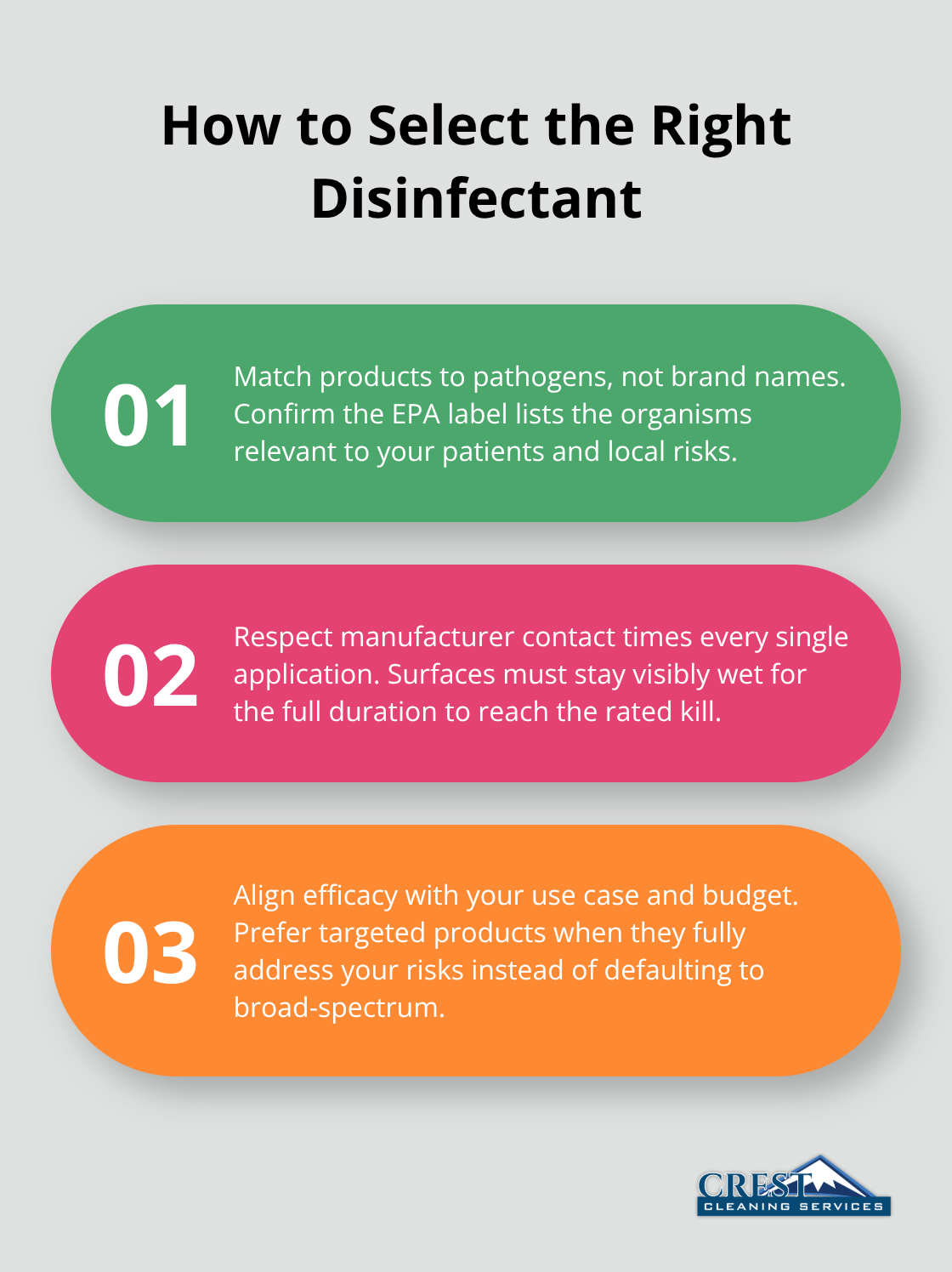
If your clinic treats respiratory patients, select a disinfectant with demonstrated virucidal activity against respiratory viruses. This targeted approach prevents wasted spending on broad-spectrum products when narrower solutions work better for your setting.
Surface Type Determines Product Selection and Method
Different surface materials require different approaches. Non-porous surfaces like stainless steel exam tables tolerate most EPA-registered disinfectants without damage, but porous materials like upholstered chairs or carpet absorb liquid and may harbor pathogens in deeper fibers where disinfectant cannot penetrate. Hard surfaces in bathrooms and around toilets demand particular attention because fecal-oral pathogens including E. coli and rotaviruses concentrate there. Quaternary ammonium compounds work well on hard surfaces and dry quickly, reducing slip hazards, while phenolic disinfectants provide broader pathogen coverage but require longer contact times and better ventilation. Electronic equipment like keyboards and computer monitors need disinfectants that evaporate quickly to prevent water damage; alcohol-based products are preferable here despite shorter contact times because they dry within seconds.
Train Staff and Document Contact Times for Compliance
Train your staff to read labels, measure contact time with a watch or timer during the first week of implementation, and document actual contact times on cleaning logs to prove compliance with manufacturer instructions. This two-step process (cleaning first, then disinfecting) takes discipline and time, which is why medical offices frequently fail at infection control despite purchasing expensive disinfectants. Staff who understand why contact time matters will execute protocols correctly rather than rushing through the work. Proper disinfection requires the right products, correct application methods, and trained personnel who follow procedures consistently-which brings us to the high-touch surfaces where infection transmission accelerates most rapidly.
Where Infection Spreads Fastest in Your Office
High-Touch Surfaces Drive Pathogen Transmission
Exam tables, door handles, and light switches in your medical office act as pathogen highways. The CDC reports that healthcare-associated infections affect roughly 1 in 31 hospital patients on any given day, and environmental surfaces play a direct role in transmission. Surfaces that staff and patients touch dozens of times per day-door handles, keyboards, reception desk counters, toilet flush handles, faucet knobs-become contaminated within hours of a sick person’s contact. A single patient with norovirus leaves viable virus particles on a door handle for days if that surface lacks proper disinfection. In shared office spaces, this problem intensifies because employees from different departments touch the same elevator buttons, conference room tables, and bathroom fixtures throughout the day.
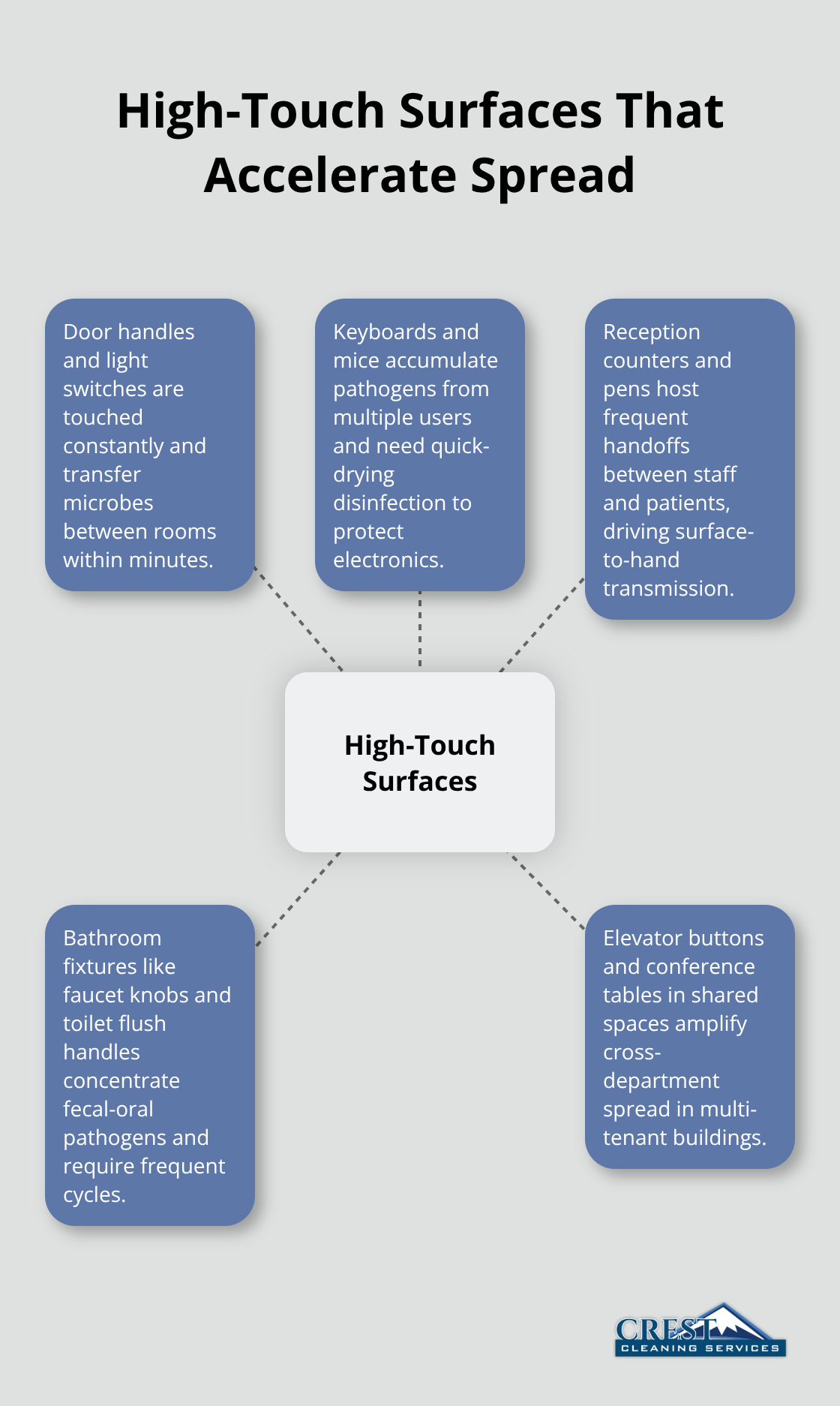
Your disinfection strategy must prioritize high-touch surfaces ruthlessly, or your other efforts waste resources.
Disinfection Frequency Depends on Traffic and Risk Level
Frequency matters more than most managers acknowledge, and it depends entirely on your traffic level and patient population. A dermatology clinic with low-risk patients needs different protocols than an urgent care facility treating respiratory infections. High-traffic areas in waiting rooms and bathrooms require disinfection at minimum twice daily-once in the morning before patients arrive and once during lunch when foot traffic dips. Bathrooms demand even more attention because fecal-oral pathogens like E. coli and rotaviruses concentrate on toilet seats, handles, and sinks; disinfect these areas three times daily in busy clinics. Exam rooms require disinfection between every patient, not at end-of-day, because the next patient sits on contaminated surfaces within minutes.
Train Staff to Identify and Prioritize Critical Areas
Staff training determines whether these schedules actually happen. Train your team to recognize high-touch surfaces by asking them to trace a patient’s journey through your clinic: what do they touch first, second, third? That sequence reveals your disinfection priorities. Provide each staff member with a laminated checklist showing which surfaces require disinfection and the required contact times for your chosen disinfectant. Time-stamp your cleaning logs so you have proof that disinfection occurred when scheduled, not guesswork. Staff who understand the infection control chain-that a single contaminated surface can infect multiple patients in sequence-execute protocols with purpose rather than rushing through motions. This foundation of trained personnel and documented procedures sets the stage for the compliance systems that prove your infection control efforts actually work.
Documentation and Compliance for Infection Control
Create Disinfection Logs That Prove Your Work
Documentation transforms infection control from good intentions into measurable compliance. Without written records, you cannot prove to regulatory inspectors, patients, or your own leadership that disinfection happened on schedule with the correct contact times. OSHA requires that healthcare facilities maintain records of cleaning and disinfection procedures, and the CDC expects documented evidence that your protocols match published guidance.
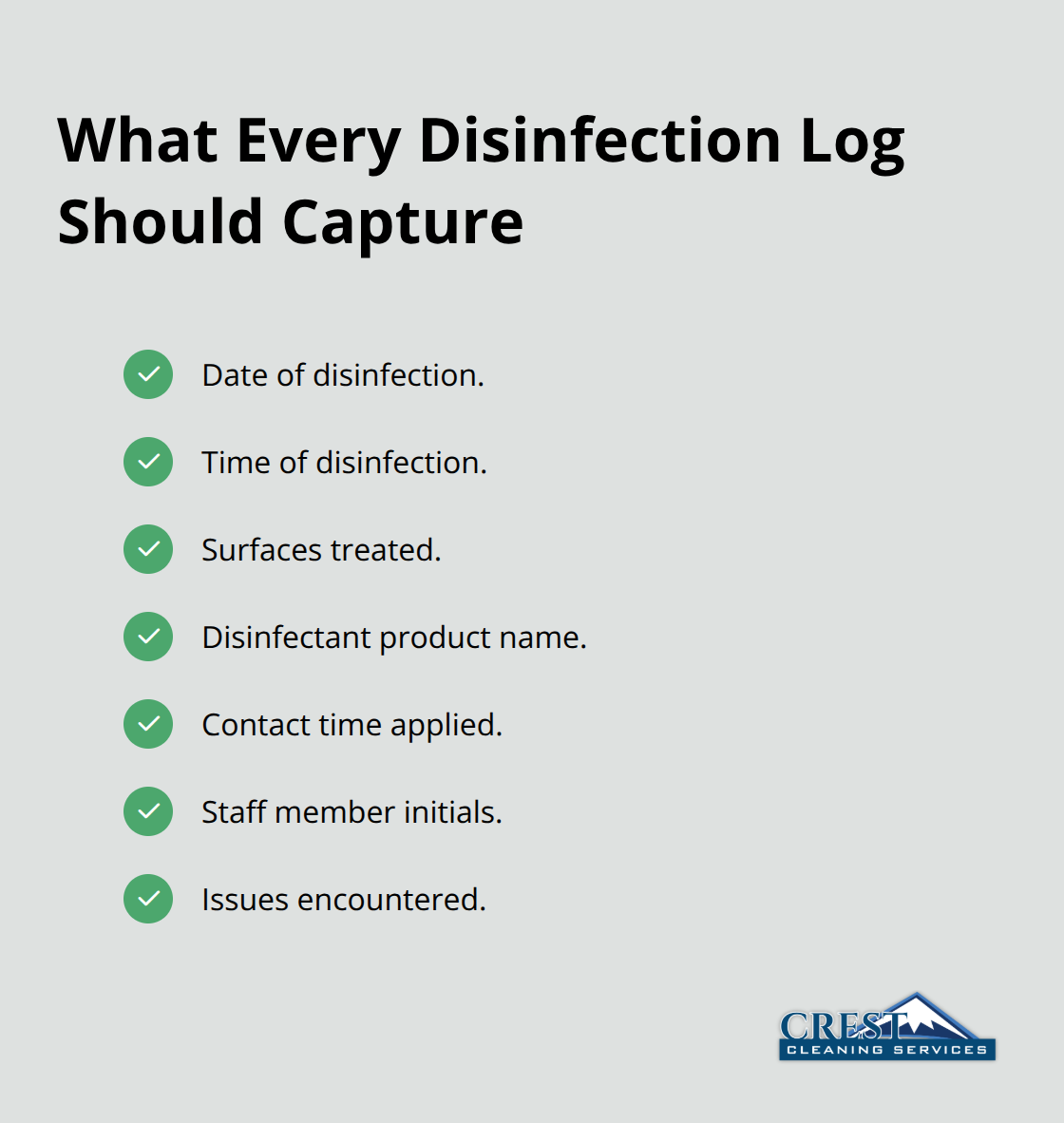
Start with a disinfection log specific to each area of your clinic or office. The log should include the date, time of disinfection, surfaces treated, disinfectant product name, contact time applied, staff member initials, and any issues encountered.
A paper log works if you laminate it and keep it in a central location, but digital tracking through a simple spreadsheet or dedicated cleaning app reduces errors and prevents staff from backdating entries. Train your team to complete logs in real time, not at end of day, because memory fails and rushed documentation breeds compliance gaps.
Match Your Practices to CDC and OSHA Standards
Meeting CDC and OSHA standards requires matching your documented practices to published guidance. The CDC provides specific disinfection recommendations for different pathogens and surface types, and your logs must reference which CDC guidance you follow for each disinfection protocol. OSHA doesn’t prescribe exact disinfectants but demands that your chosen products and methods align with recognized infection-control standards.
Your logs become your defense if an infection outbreak occurs or a regulatory agency questions your procedures. They prove that you followed manufacturer instructions and regulatory expectations consistently.
Audit Your Logs Monthly to Catch Compliance Gaps
Audit your cleaning logs monthly by sampling three to five random days and verifying that the documented contact times match your chosen disinfectant’s label requirements. If your logs show 30-second contact times but your disinfectant requires 10 minutes, you have a training or compliance failure. Compare your actual disinfection frequency against the risk level of each area; high-traffic bathrooms should show three disinfections daily, exam rooms should show disinfection between every patient, and waiting areas should show at least twice-daily treatment.
If your audit reveals consistent gaps, increase staff training or reduce the scope of areas assigned to individual team members so they can execute protocols without rushing. This monthly review prevents drift before it becomes a liability.
Consider Professional Services to Eliminate Documentation Risk
Professional cleaning services eliminate this risk entirely because trained external teams follow standardized checklists and maintain centralized documentation that meets regulatory requirements automatically. When you partner with a professional cleaning company (especially one that uses W2 employees rather than subcontractors and provides trained, background-checked teams), you transfer the burden of compliance documentation to specialists who handle it as their core responsibility.
Final Thoughts
Effective infection control cleaning tips require three non-negotiable elements: EPA-registered disinfectants applied with correct contact times, documented protocols for high-touch surfaces, and staff training that transforms procedures into consistent practice. Without all three, your clinic or office remains vulnerable to pathogen transmission regardless of how much you spend on products. The strategies outlined in this guide work only when your team executes them daily and your logs prove compliance to regulators and patients alike.
Building this system internally demands significant time investment from your staff, who must learn label requirements, measure contact times accurately, complete logs consistently, and audit their own work monthly. Many medical offices and shared workspaces struggle with this burden because cleaning compliance competes with patient care and administrative tasks for limited attention, and staff shortcuts happen naturally when protocols feel burdensome. Professional cleaning services eliminate this operational friction entirely by handling compliance as their core responsibility.
We at Crest Cleaning Services have served medical offices and clinics throughout the Seattle area since 2011, and we build disinfection schedules based on your actual traffic patterns and patient population rather than applying generic protocols to every space. Our W2 employees receive training on infection control standards, follow documented checklists for each area, and maintain centralized records that satisfy regulatory requirements automatically. Contact Crest Cleaning Services to discuss how professional cleaning protocols protect your patients and reduce your compliance risk.
Crest Cleaning Services is a locally owned cleaning company based in Auburn, Washington. We provide commercial janitorial, office cleaning, apartment common area cleaning, carpet and floor care, move out cleaning, and recurring house cleaning throughout the greater Seattle area. We serve Auburn, Kent, Seattle, Bellevue, Renton, Federal Way, Tacoma, and surrounding communities.
Learn more at [www.crestcleans.com](http://www.crestcleans.com)