Your office or medical facility’s indoor air quality directly affects employee productivity and patient outcomes. VOC compliant carpet cleaning removes harmful chemical residues that standard products leave behind, protecting the health of everyone who walks through your doors.
For help with this type of cleaning, explore Crest Cleaning Services’ commercial carpet cleaning, or request a quote.
At Crest Cleaning Services, we’ve seen firsthand how switching to low-VOC methods transforms workplace environments. This guide shows you exactly what VOCs are, which certifications matter, and how to make the transition without disrupting your operations.
What VOCs Actually Are and Why Your Office Needs to Care
Understanding Volatile Organic Compounds
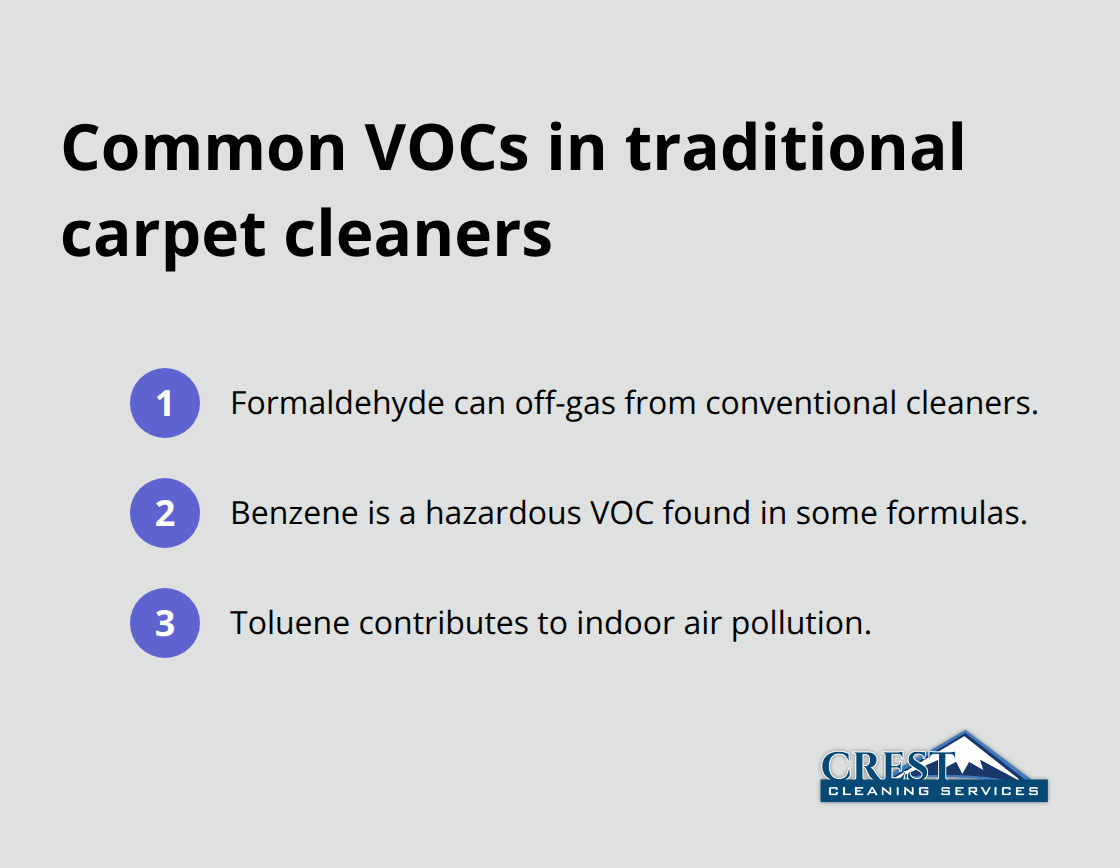
Volatile organic compounds are chemicals that evaporate at room temperature and become airborne in your office or medical facility. Common VOCs in traditional carpet cleaning products include formaldehyde, benzene, and toluene.
Concentrations of many VOCs are consistently higher indoors (up to ten times higher) than outdoors. When a professional cleaner applies standard carpet treatments, those chemicals don’t simply vanish after the carpet dries-they off-gas for weeks or even months, continuously releasing harmful compounds into your breathing space.
The Hidden Cost of Poor Air Quality
This matters significantly in medical offices and clinics where patient immune systems may already be compromised. Office managers often overlook that poor indoor air quality costs money through employee absences and reduced productivity. Harvard’s School of Public Health found that improved air quality in offices increased cognitive function scores by 101 percent. Your staff’s ability to focus, make decisions, and work efficiently takes a direct hit when they breathe in chemical residues from carpet cleaning.
Regulatory Demands in Healthcare Settings
Healthcare facilities face stricter requirements because patient safety regulations demand better air quality standards. The Joint Commission, which accredits medical facilities, emphasizes environmental controls that include chemical exposure reduction. Medical offices cannot afford to have patients or staff experiencing respiratory irritation, headaches, or allergic reactions triggered by cleaning products. Low-VOC and zero-VOC carpet cleaning products eliminate these risks entirely.
Why Certifications Matter
Certifications like Green Seal and the Carpet and Rug Institute’s Green Label Plus exist specifically because facility managers demanded proof that products wouldn’t harm their environments. These third-party verifications provide concrete assurance that your cleaning methods meet established safety standards. When you switch to VOC-compliant cleaning, you’re not making an environmental statement-you’re making a business decision that protects employee health, reduces sick days, and meets regulatory expectations that keep your facility compliant. Understanding which certifications carry real weight becomes your next step in selecting the right cleaning partner.
What Low-VOC Cleaning Products Actually Deliver
How Low-VOC Products Work Differently
The carpet cleaning market has fractured into two camps, and the difference matters more than most facility managers realize. Traditional carpet cleaners rely on synthetic surfactants and petroleum-based solvents that strip dirt effectively but leave behind chemical residues that off-gas for weeks. Low-VOC products work differently-they use plant-based surfactants, water-based solutions, and encapsulation technology that traps soil particles without requiring harsh chemicals to evaporate into your air. The Carpet and Rug Institute’s Green Label Plus program tests products to ensure they emit less than 0.5 mg/m³ of VOCs within 24 hours of application. This isn’t a marginal difference-it’s the distinction between carpet that continues releasing formaldehyde for a month and carpet that’s safe to occupy within hours.
Performance That Matches Traditional Methods
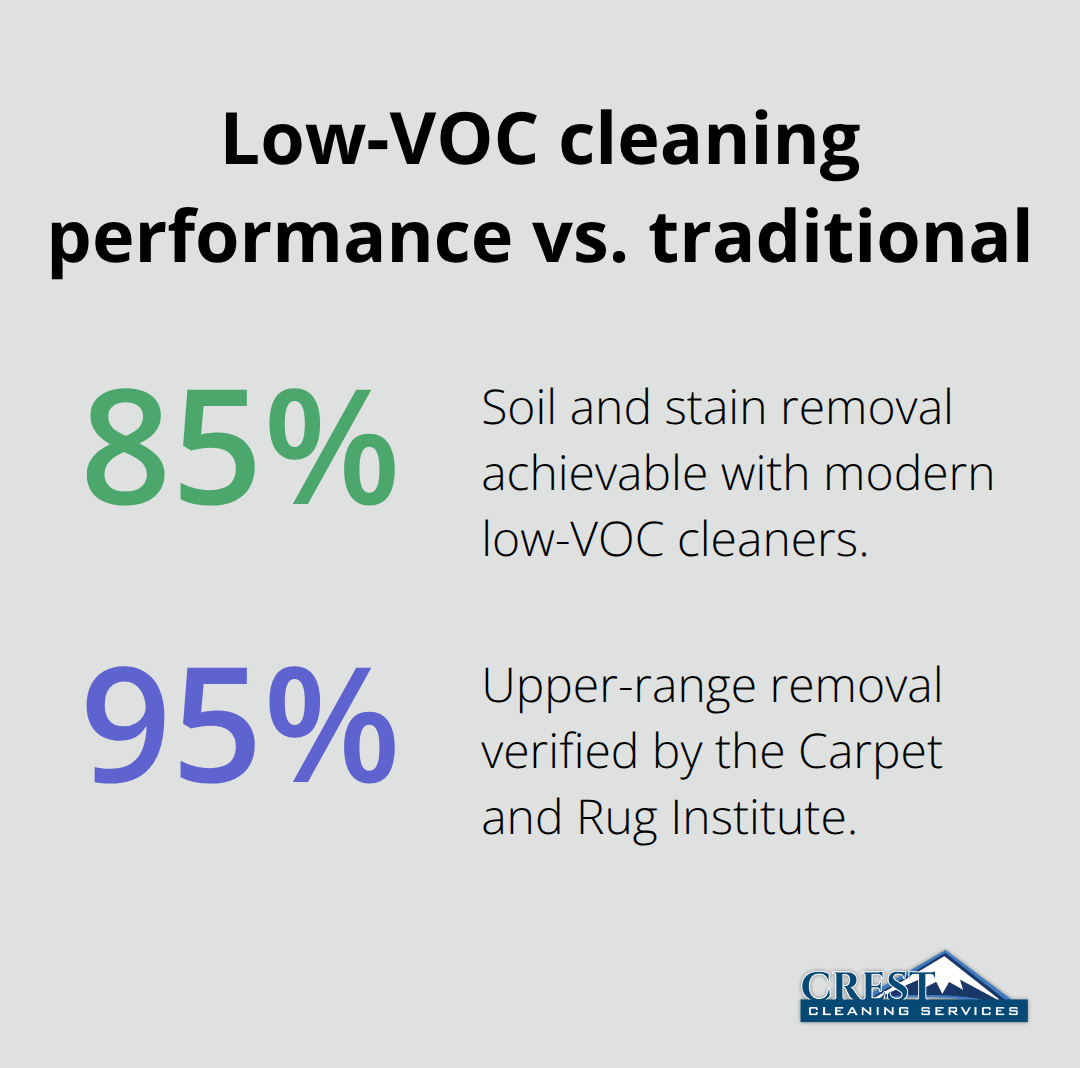
The performance gap has closed dramatically over the past five years. Modern low-VOC cleaners remove 85 to 95 percent of soil and stains compared to traditional products, according to independent testing by the Carpet and Rug Institute. Encapsulation technology, which uses specialized polymers to crystallize dirt particles, actually prevents re-soiling better than older methods because it doesn’t leave sticky residue that attracts new dirt.
Professional cleaners apply these products through hot water extraction paired with low-VOC detergents, or through dry-compound methods using biodegradable encapsulants that require minimal drying time.
Operational Benefits for Medical Offices
Medical offices benefit particularly from reduced drying time-your facility stays fully operational within two to four hours instead of requiring overnight closure. This means your staff and patients experience minimal disruption while you still receive thorough carpet cleaning. The faster turnaround also reduces the window during which any residual chemicals could off-gas into occupied spaces.
The Real Cost Picture
Low-VOC cleaning costs roughly 10 to 15 percent more per application than traditional methods, but healthcare facilities and offices recoup this investment through fewer sick days, reduced HVAC strain from chemical off-gassing, and compliance with Joint Commission standards without expensive remediation later. When you calculate the true cost of employee absences, reduced productivity, and potential regulatory violations, the premium for low-VOC products disappears. Understanding which certifications actually carry weight in your industry becomes the next step in selecting the right cleaning partner.
Which Certifications Actually Matter for Your Facility
Green Seal vs. Environmental Choice Standards
Green Seal and Environmental Choice certifications represent the gold standard for carpet cleaning products, but most office managers and medical decision-makers treat them as interchangeable when they’re not. Green Seal certified products establish requirements for industrial and institutional general-purpose, restroom, glass, and carpet cleaners, with third-party testing before certification, making it the more rigorous standard. Environmental Choice certifications vary by country and program, with some versions requiring less stringent testing than others. When you’re evaluating cleaning companies, ask specifically whether they use Green Seal certified products and request documentation of that certification rather than accepting vague claims about low-VOC methods.
Why Medical Offices Prioritize Green Seal
Medical offices should prioritize Green Seal above all other labels because it’s the only certification that carries weight with Joint Commission inspectors who evaluate your facility’s environmental controls. Joint Commission standards emphasize chemical exposure reduction as part of patient safety protocols, and inspectors recognize Green Seal as the legitimate proof that your cleaning methods meet those requirements. This distinction protects your facility from compliance violations and demonstrates to regulators that you take environmental controls seriously.
Understanding LEED and Building Certifications
LEED standards for building certification include indoor air quality requirements, but LEED itself doesn’t certify individual cleaning products-it certifies entire buildings based on their cumulative environmental practices. This distinction matters because a cleaning company claiming LEED compliance might simply mean they follow practices that contribute to a building’s LEED status, not that their products meet specific VOC standards. You need product-level certifications, not building-level claims, to guarantee that your carpets won’t off-gas harmful chemicals.
Third-Party Testing and Verification Labels
The Carpet and Rug Institute’s Green Label Plus program tests products in accredited laboratories and publishes results publicly, giving you access to actual emission data rather than marketing language. Third-party testing through independent labs provides the most reliable verification, and you should request test reports showing VOC emissions measured in mg/m³ within 24 hours of application. These reports contain measurable data that proves whether a product actually meets low-VOC standards or simply claims to do so without evidence.
Requesting Documentation From Your Cleaner
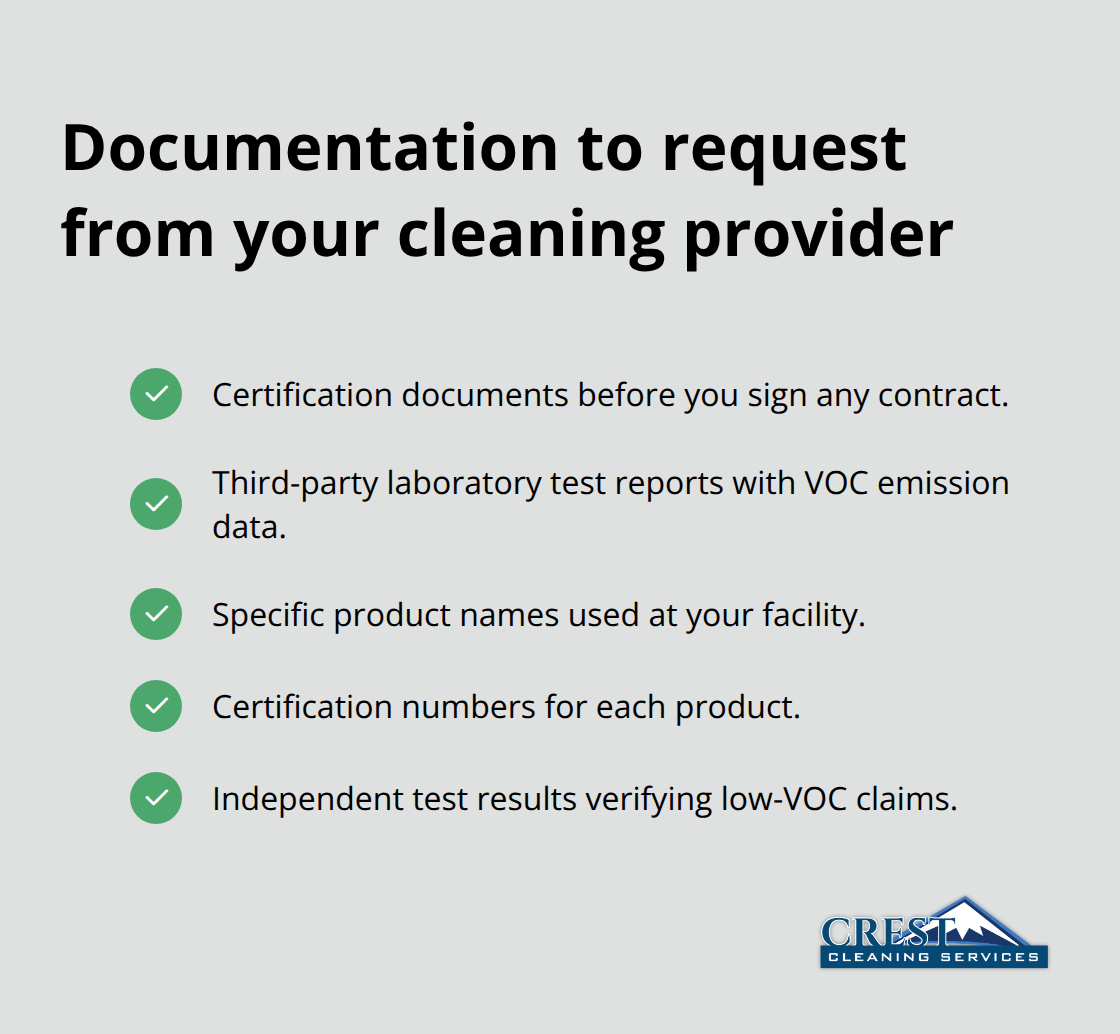
When you select a cleaning partner, request certification documents and test reports before signing any contract. Legitimate cleaning companies (including those serving the Auburn, Kent, Seattle, and surrounding areas) maintain these records and provide them readily to demonstrate their commitment to safe products. Ask for specific product names, certification numbers, and third-party test results rather than accepting general assurances about low-VOC methods.
Making the Switch to VOC-Compliant Cleaning
Start your transition by asking your current cleaning provider which products they apply and request the product names, not vague descriptions. Cross-reference those products against Green Seal certification databases and the Carpet and Rug Institute’s Green Label Plus program to see whether they actually meet low-VOC standards. Most office managers discover their existing cleaners use traditional products simply because nobody asked for alternatives, and this gap represents your opportunity to improve air quality without operational disruption.
Professional cleaners trained in low-VOC methods understand how to apply these products correctly, which affects both performance and safety. At Crest Cleaning Services, we work with medical offices and commercial facilities throughout the Auburn, Kent, Seattle, and surrounding areas to transition their carpet cleaning to certified low-VOC solutions. Our teams know which products deliver results while keeping your facility compliant with Joint Commission standards and other regulatory requirements.
Track employee sick days for 60 days before and after you switch to VOC compliant carpet cleaning, noting any changes in respiratory complaints or headaches reported to your facilities team. Request indoor air quality testing from a local environmental consultant who can measure VOC concentrations before and after your first low-VOC cleaning application. Medical offices should document these improvements for Joint Commission records, creating a compliance trail that demonstrates your commitment to patient safety.
Crest Cleaning Services is a locally owned cleaning company based in Auburn, Washington. We provide commercial janitorial, office cleaning, apartment common area cleaning, carpet and floor care, move out cleaning, and recurring house cleaning throughout the greater Seattle area. We serve Auburn, Kent, Seattle, Bellevue, Renton, Federal Way, Tacoma, and surrounding communities.
Learn more at [www.crestcleans.com](http://www.crestcleans.com)