Most property managers don’t realize how much confusion surrounds supplies provided by cleaners in commercial contracts. Hidden markups, unclear ownership terms, and vague stocking responsibilities can drain your budget fast.
We at Crest Cleaning Services have seen countless contracts that leave property managers exposed to unexpected costs. This guide breaks down exactly what you should expect, what you should negotiate, and how to protect your bottom line.
What Supplies Should Your Janitorial Contractor Provide
Paper Products and Dispensers
Most commercial janitorial contracts bundle supplies into packages, but what’s actually included varies wildly. Paper products typically cover toilet paper, paper towels, and napkins, though some contractors charge separately for premium brands or higher volumes. Dispensers themselves are often a gray area-contractors may provide them at no cost, include them as part of the supply fee, or charge rental fees that range from $5 to $15 per dispenser monthly. The key question is whether the contractor owns and maintains these dispensers or if your property does. Many contracts leave this detail ambiguous, which creates disputes when dispensers malfunction or go missing.
Cleaning Chemicals and Solutions
Most contractors supply their own products rather than using yours, which gives them control over quality and cost. However, some facilities require specific products due to health regulations or environmental certifications-medical offices might mandate hospital-grade disinfectants, while LEED-certified buildings often require eco-friendly solutions. Request clarification on whether the contractor stocks specialty products or passes those costs to you as add-ons. This conversation prevents surprises later.
Restroom and Hygiene Supplies
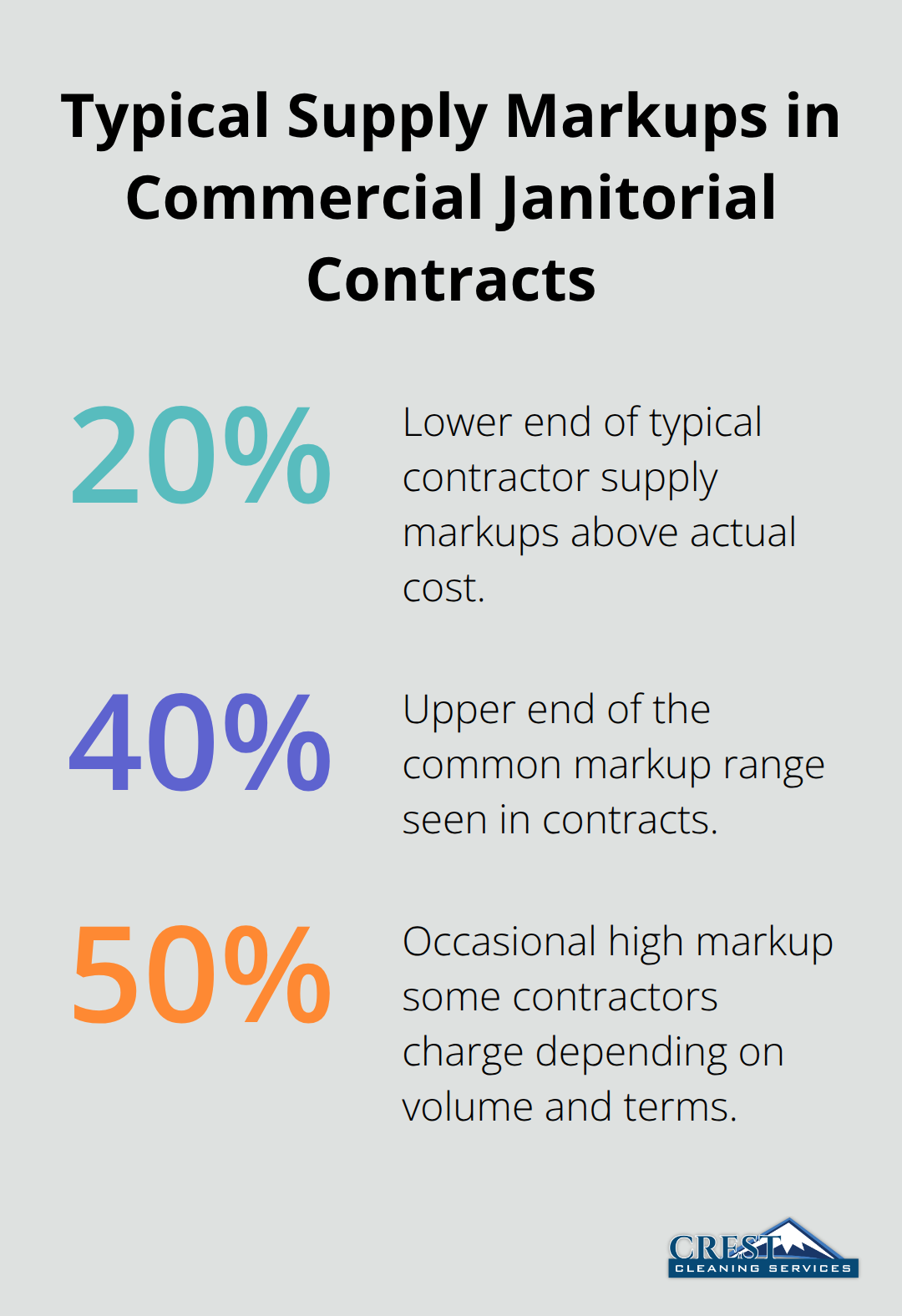
Restroom and hygiene supplies beyond the basics-hand soap, sanitizer, feminine hygiene products, air fresheners-frequently trigger unexpected charges. Many contracts list paper products but omit soap, creating a situation where you either negotiate it in writing or pay premium markups later. The industry standard shows that contractors typically mark up supplies between 20 and 40 percent above their actual cost, though some charge up to 50 percent depending on volume and contract terms.
Getting Specifics Before You Sign
The most practical step is requesting a detailed supply inventory list before signing any contract. This list should specify exactly what gets restocked, how often, minimum quantities, and who pays for each item. Don’t accept vague language like “supplies included” or “as needed”-those phrases hide costs. Ask your contractor to provide sample invoices showing supply line items and prices so you understand the markup structure upfront.
Hybrid Supply Approaches and Environmental Factors
Verify whether the contractor handles all ordering and delivery or if you’re responsible for purchasing certain items. Some property managers find they save money by stocking their own paper products through bulk suppliers, while contractors handle specialty chemicals. This hybrid approach works only if your contract explicitly permits it and clarifies who’s responsible for what. Temperature and humidity also affect supply needs-high-traffic facilities or humid climates require more frequent restocking, which should be reflected in your contract terms rather than triggering surprise invoices mid-year. Understanding these variables now positions you to negotiate ownership and stocking responsibilities that actually fit your property’s needs.
Ownership and Stocking Responsibilities
Who Pays for What
The biggest mistake property managers make is assuming their janitorial contractor covers all supplies when the contract actually splits costs in ways nobody explains upfront. Contractors provide some items, you pay for others, and a third category sits in a gray zone where disputes happen. The International Sanitary Supply Association reports that contractors typically cover cleaning chemicals, floor care products, and equipment maintenance, while property managers fund paper products, soap, and specialty restroom items in roughly 60 percent of commercial contracts. This split creates confusion because contractors often mark up their supplied items between 25 and 40 percent above wholesale cost, then quote you separately for items you’re responsible for at similar markup rates. You end up paying twice over-once through the contractor’s supply fee and again through marked-up add-ons.
Start by asking your contractor which category each supply falls into: contractor-provided and included in the monthly fee, contractor-provided but billed separately with markup, or property manager responsibility. Get this breakdown in writing before you sign anything.
Equipment Ownership and Maintenance Costs
Equipment ownership matters just as much as supply costs but rarely gets negotiated properly. When a contractor provides mop heads, floor buffers, or restroom dispensers, you need to clarify whether you own them, the contractor does, or you share ownership. Many contracts state the contractor owns equipment but leave maintenance responsibility vague, meaning a broken dispenser becomes your problem to fix or replace even though you don’t own it.
Request that your contract explicitly state who replaces damaged equipment and who covers repair costs. Some contractors include equipment replacement in their monthly fee, others charge for it separately, and a few pass costs directly to you without warning. The practical approach involves requesting an equipment inventory list with replacement costs specified before you sign.
Dispenser Fees and Restocking Schedules
For paper product dispensers specifically, negotiate whether the contractor stocks them at no additional rental fee or if you accept a monthly per-dispenser charge. Costs range from $5 to $15 monthly per dispenser depending on the contractor and your location, which adds up fast across a large property. A 50-unit facility could pay $250 to $750 monthly just for dispenser rentals-money that compounds annually.
Stocking responsibility should also be crystal clear. How often does the contractor restock? What happens if supplies run out mid-day? Who pays for emergency restocking if traffic exceeds normal levels? High-traffic facilities need more frequent restocking, and your contract should account for this with specific restocking schedules and quantities rather than vague language like “supplies delivered as needed.” These details prevent disputes and protect your budget from unexpected charges when your property’s actual needs exceed what the contractor anticipated.
How Contractors Hide Costs in Supply Pricing
Markup practices in janitorial contracts operate on a simple principle: contractors charge you significantly more than they pay for supplies, then structure contracts so you never see the actual wholesale costs. The problem isn’t the markup itself-contractors need margin to operate-it’s that many contracts obscure these markups entirely, making it impossible to know if you’re paying fair market rates or inflated prices. Request an itemized breakdown showing contractor cost versus your price for every supply category before you sign anything. If a contractor refuses this transparency, that’s a red flag worth taking seriously.
When you see actual numbers side-by-side, you can negotiate intelligently and identify where you’re overpaying. Clear pricing from the start prevents hidden costs from eroding your budget unnecessarily.
Understanding Different Pricing Models
Pricing models vary widely, and each structure creates different opportunities for contractors to embed hidden costs. Some contractors bundle supplies into a flat monthly fee, making it impossible to separate paper product costs from chemical costs or equipment rental fees. Others charge a base cleaning fee, then layer on supply costs, equipment rental, and restocking charges as separate line items-this approach looks more transparent but often results in higher total costs because each line item carries its own markup.
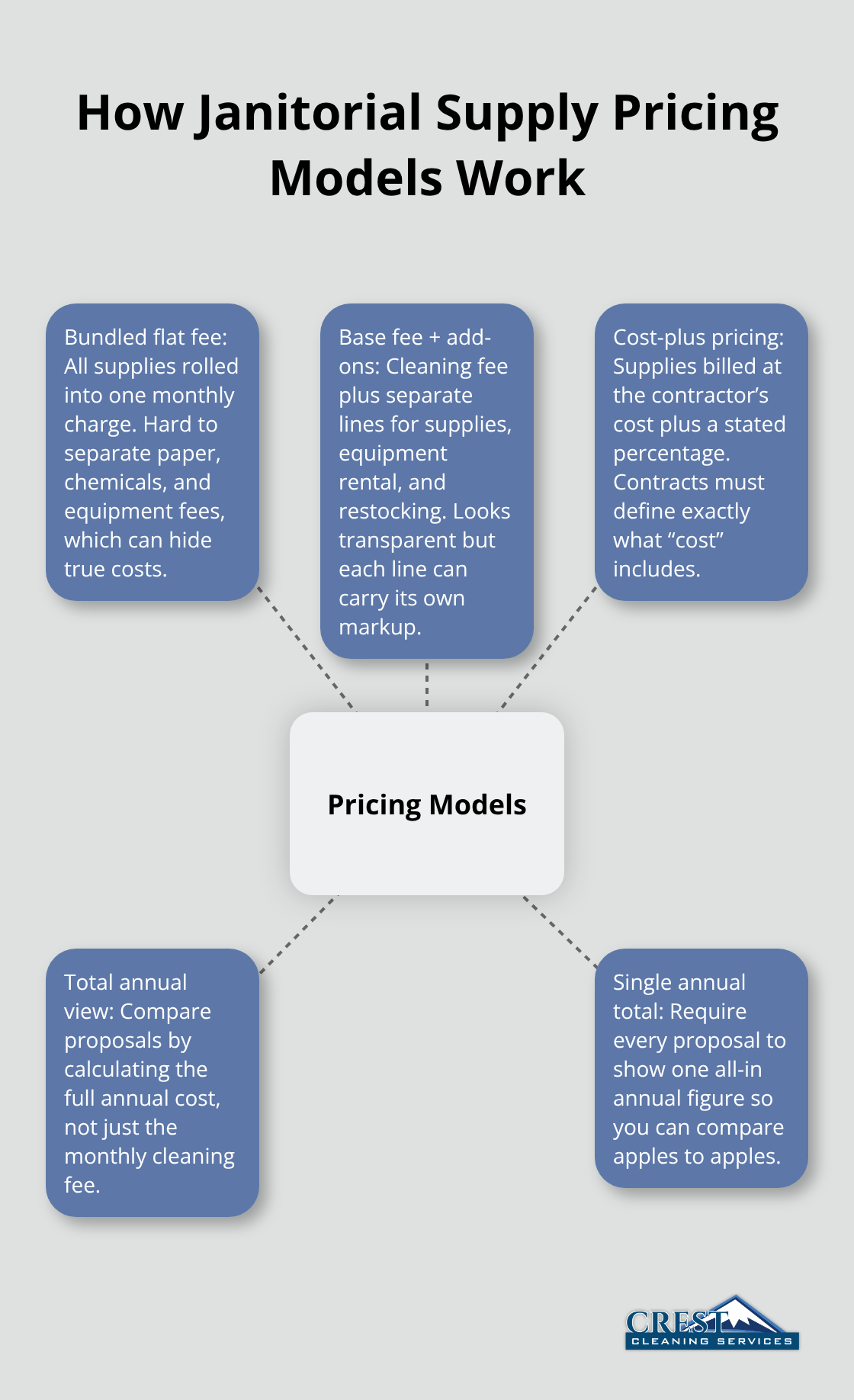
A third model charges supplies at cost-plus pricing, which sounds fair but rarely includes a clear definition of what cost means. Does it include their warehouse overhead, delivery costs, or just the product itself? Your contract must specify exactly which model applies and what each line item includes. When you evaluate proposals, calculate your total annual cost under each pricing model rather than focusing on the monthly cleaning fee alone. A contractor quoting $2,000 monthly for cleaning might add $800 to $1,200 in monthly supply costs depending on how they structure pricing, making the real cost $2,800 to $3,200 monthly. Demand that all costs appear in a single annual total so you can compare contractor proposals accurately. Many property managers pay 15 to 25 percent more than necessary simply because they compared cleaning fees without including supply markups in their analysis.
Contract Clauses That Protect Your Interests
Your contract needs specific language around supply costs, ownership, and price increases because vague clauses create disputes that cost far more than the supplies themselves. Include a clause that caps supply markup at a specific percentage-25 percent is standard and defensible, while 40 percent or higher should trigger negotiation. Require the contractor to provide quarterly or annual cost documentation showing what they paid for supplies versus what they charged you, giving you visibility into whether markups remain consistent or creep upward over time.
Add language requiring 30 days written notice before any price increase, and specify that increases apply only to new supply items or cost increases from suppliers-not retroactive increases on supplies already included in your contract. Many contractors quietly increase markups annually without notification, and your contract should explicitly prohibit this practice. Address dispenser rental fees separately from supply costs, with a maximum monthly fee per unit and a clause allowing you to reject dispenser rental charges and purchase dispensers yourself if costs exceed your threshold. Include a termination clause allowing either party to exit the contract with 30 days notice if supply costs increase more than 5 percent annually, protecting you from being locked into unfavorable pricing. Specify that the contractor owns and maintains equipment provided under the contract, not you, eliminating disputes over replacement costs when dispensers break or go missing. Request a clause permitting you to audit supply invoices annually, ensuring contractors can’t hide markup increases in complex billing statements.
Protecting Your Budget Through Active Monitoring
The most effective way to avoid hidden costs is establishing baseline metrics before the contract starts. Request a detailed supply consumption forecast from your contractor showing quantities and costs for the first year, broken down monthly. As the contract progresses, track actual supply usage against this forecast and flag any increases that exceed 10 percent without corresponding increases in facility usage or traffic.
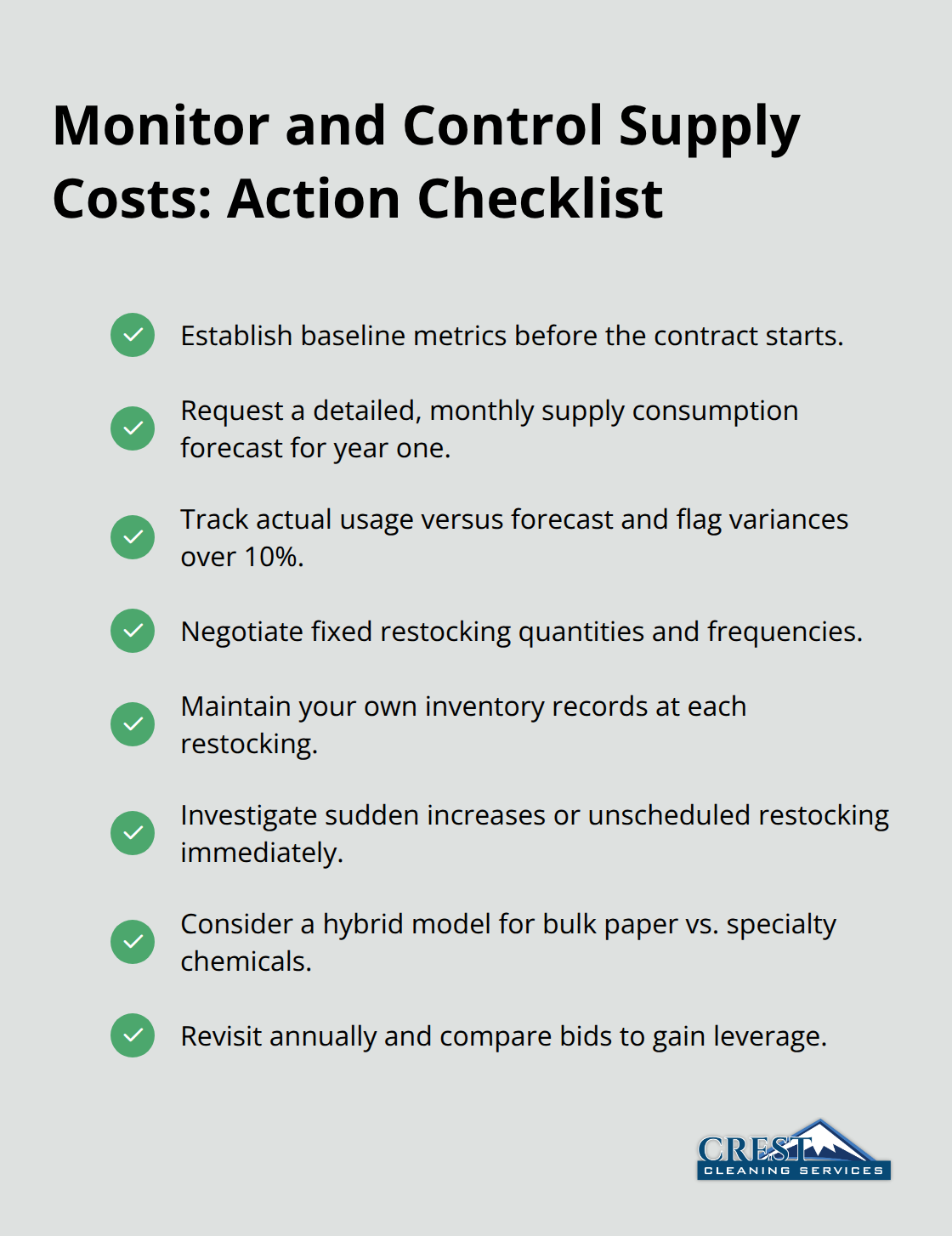
If your contractor suddenly restocks more frequently or bills for additional supplies, investigate immediately rather than paying without question.
Negotiate fixed supply quantities and frequencies into your contract rather than accepting open-ended language like supplies delivered as needed. For example, specify that restrooms receive paper product restocking three times weekly, soap refills twice weekly, and specialty items monthly. This specificity prevents contractors from adding unscheduled restocking and billing you for emergency service charges. Maintain your own inventory records for supplies the contractor provides, counting items during restocking and documenting dates and quantities. This practice catches billing discrepancies quickly and gives you evidence if disputes arise.
Consider hybrid approaches where you purchase high-volume items like toilet paper and paper towels through bulk suppliers while contractors handle specialty chemicals and restroom products-this often reduces costs by 15 to 20 percent compared to full contractor-supplied models. However, hybrid arrangements require explicit contract language clarifying who orders what, who pays for storage, and how restocking coordination happens. Finally, revisit your contract annually and request cost comparisons from other local contractors, using that information as leverage to renegotiate rates with your current provider. Contractors count on inertia and assume you’ll renew without shopping around, so demonstrating you’ve obtained competitive bids often results in meaningful price reductions.
Final Thoughts
Supplies provided by cleaners represent one of the largest hidden cost areas in commercial janitorial contracts, yet most property managers negotiate them poorly or not at all. The difference between a well-negotiated supply agreement and a poorly structured one costs you $5,000 to $15,000 annually on a mid-sized commercial property. You now understand what to expect, where contractors hide costs, and exactly which contract clauses protect your budget.
The foundation of any successful janitorial relationship starts with clear communication about supplies, ownership, and pricing before you sign anything. Vague contracts create disputes that damage your relationship with your contractor and drain your budget through unexpected charges. Specific, detailed agreements prevent these problems entirely-request itemized supply lists, demand transparent pricing breakdowns, and insist on written clarification of who owns equipment and who pays for what.
Pull your current janitorial contract and compare it against the standards outlined here to identify gaps in protection. If your contract lacks these protections, contact your current contractor and request amendments before your renewal date, or evaluate other providers who offer transparent pricing and detailed agreements. We at Crest Cleaning Services structure contracts around clear communication and practical solutions tailored to your actual property needs rather than generic templates.
Crest Cleaning Services is a locally owned cleaning company based in Auburn, Washington. We provide commercial janitorial, office cleaning, apartment common area cleaning, carpet and floor care, move out cleaning, and recurring house cleaning throughout the greater Seattle area. We serve Auburn, Kent, Seattle, Bellevue, Renton, Federal Way, Tacoma, and surrounding communities.
Learn more at [www.crestcleans.com](http://www.crestcleans.com)